Posts tagged as:
Foreclosure Sales
WP_Query Object
(
[query_vars] => Array
(
[tag] => foreclosure-sales
[error] =>
[m] => 0
[p] => 0
[post_parent] =>
[subpost] =>
[subpost_id] =>
[attachment] =>
[attachment_id] => 0
[name] =>
[static] =>
[pagename] =>
[page_id] => 0
[second] =>
[minute] =>
[hour] =>
[day] => 0
[monthnum] => 0
[year] => 0
[w] => 0
[category_name] =>
[cat] =>
[tag_id] => 264
[author_name] =>
[feed] =>
[tb] =>
[paged] => 0
[comments_popup] =>
[meta_key] =>
[meta_value] =>
[preview] =>
[s] =>
[sentence] =>
[fields] =>
[menu_order] =>
[category__in] => Array
(
)
[category__not_in] => Array
(
)
[category__and] => Array
(
)
[post__in] => Array
(
)
[post__not_in] => Array
(
[12] => 1037
[7] => 1041
[37] => 398
[134] => 1129
[133] => 1137
[151] => 1183
[159] => 1212
[163] => 1230
[23] => 1273
[21] => 1288
[177] => 1290
[178] => 1293
[179] => 1296
[28] => 1363
[210] => 1426
[38] => 1433
[40] => 1437
[39] => 1439
[41] => 1468
[82] => 1479
[95] => 1475
[44] => 1481
[10] => 1484
[22] => 1487
[48] => 1490
[47] => 1492
[51] => 1494
[50] => 1499
[46] => 1503
[108] => 1505
[17] => 1508
[219] => 1510
[220] => 1512
[221] => 1514
[225] => 1516
[223] => 1518
[222] => 1520
[226] => 1522
[224] => 1524
[241] => 1543
[240] => 1545
[242] => 1547
[243] => 1549
[3] => 1834
[26] => 1617
[16] => 119
[13] => 1773
[49] => 1497
[36] => 1435
[20] => 2034
[19] => 2091
[31] => 2151
[5] => 2185
[253] => 2831
[251] => 2833
[257] => 2835
[261] => 2838
[387] => 6752
[388] => 6760
[389] => 6847
[390] => 7000
[392] => 7124
[394] => 9030
[404] => 1463
[405] => 1460
[406] => 1456
[408] => 1453
[409] => 1449
[407] => 1446
[412] => 10408
[411] => 10410
[415] => 11326
[414] => 11428
[416] => 11342
[417] => 11357
[418] => 11366
[419] => 11405
[420] => 11380
[427] => 11564
[431] => 11560
[428] => 11558
[425] => 11574
[424] => 11568
[426] => 11570
[423] => 11674
[438] => 12427
[439] => 12400
[437] => 12303
[440] => 12301
[441] => 12356
[435] => 12342
[434] => 12278
[433] => 12251
[436] => 12441
[444] => 12600
[443] => 12580
[442] => 12542
)
[tag__in] => Array
(
)
[tag__not_in] => Array
(
)
[tag__and] => Array
(
)
[tag_slug__in] => Array
(
[0] => foreclosure-sales
)
[tag_slug__and] => Array
(
)
[ignore_sticky_posts] =>
[suppress_filters] =>
[cache_results] => 1
[update_post_term_cache] => 1
[update_post_meta_cache] => 1
[post_type] =>
[posts_per_page] => 10
[nopaging] =>
[comments_per_page] => 50
[no_found_rows] =>
[order] => DESC
)
[tax_query] => WP_Tax_Query Object
(
[queries] => Array
(
[0] => Array
(
[taxonomy] => post_tag
[terms] => Array
(
[0] => foreclosure-sales
)
[include_children] => 1
[field] => slug
[operator] => IN
)
)
[relation] => AND
)
[meta_query] => WP_Meta_Query Object
(
[queries] => Array
(
)
[relation] =>
)
[post_count] => 6
[current_post] => -1
[in_the_loop] =>
[comment_count] => 0
[current_comment] => -1
[found_posts] => 6
[max_num_pages] => 1
[max_num_comment_pages] => 0
[is_single] =>
[is_preview] =>
[is_page] =>
[is_archive] => 1
[is_date] =>
[is_year] =>
[is_month] =>
[is_day] =>
[is_time] =>
[is_author] =>
[is_category] =>
[is_tag] => 1
[is_tax] =>
[is_search] =>
[is_feed] =>
[is_comment_feed] =>
[is_trackback] =>
[is_home] =>
[is_404] =>
[is_comments_popup] =>
[is_paged] =>
[is_admin] =>
[is_attachment] =>
[is_singular] =>
[is_robots] =>
[is_posts_page] =>
[is_post_type_archive] =>
[query_vars_hash] => 54633fc35df23e2be73e2b9e92a4471b
[query_vars_changed] => 1
[thumbnails_cached] =>
[query] => Array
(
[tag] => foreclosure-sales
)
[request] => SELECT SQL_CALC_FOUND_ROWS wp_posts.ID FROM wp_posts INNER JOIN wp_term_relationships ON (wp_posts.ID = wp_term_relationships.object_id) WHERE 1=1 AND wp_posts.ID NOT IN (1037,1041,398,1129,1137,1183,1212,1230,1273,1288,1290,1293,1296,1363,1426,1433,1437,1439,1468,1479,1475,1481,1484,1487,1490,1492,1494,1499,1503,1505,1508,1510,1512,1514,1516,1518,1520,1522,1524,1543,1545,1547,1549,1834,1617,119,1773,1497,1435,2034,2091,2151,2185,2831,2833,2835,2838,6752,6760,6847,7000,7124,9030,1463,1460,1456,1453,1449,1446,10408,10410,11326,11428,11342,11357,11366,11405,11380,11564,11560,11558,11574,11568,11570,11674,12427,12400,12303,12301,12356,12342,12278,12251,12441,12600,12580,12542) AND ( wp_term_relationships.term_taxonomy_id IN (269) ) AND wp_posts.post_type = 'post' AND (wp_posts.post_status = 'publish') GROUP BY wp_posts.ID ORDER BY wp_posts.post_date DESC LIMIT 0, 10
[posts] => Array
(
[0] => WP_Post Object
(
[ID] => 3239
[post_author] => 2
[post_date] => 2009-03-26 15:14:31
[post_date_gmt] => 2009-03-26 20:14:31
[post_content] => “After weeks of negotiating the purchase (of a bank-owned home) . . . it turned out the bank didn’t actually own the property, and had wrongfully foreclosed on the home.”
This amazing quote is from an irate employee of an affordable housing organization trying to buy a foreclosed home.
The man wasted weeks of time and effort dealing with the seemingly overworked and overwhelmed loss mitigation department of a major lender. The department didn’t even know the bank didn’t have ownership rights to this home, one of the hundreds of foreclosed properties it was trying to sell!
This cautionary story appears in the current edition of Banker and Tradesman, the respected Massachusetts real estate trade publication.
It illustrates the nightmare of frustration and wasted time sometimes encountered by buyers seeking to buy REO (bank-owned) property.
Quoting again from the article:
“Lenders have been woefully unprepared to deal with the administration and listing of their properties; often, they aren’t even aware that a property is theirs.”
A look at the numbers helps explain why REO lenders are often so dysfunctional with the management and sale of foreclosed properties: there are approximately 5000 REO properties currently in Massachusetts, according to The Warren Group, publisher of Banker & Tradesman. Of those, about 1,700 are being administered by US Bank and Deutsche Bank, the two largest servicers of REO properties in the state.
That’s a lot of homes to handle!
When you add in the 1000s of short sales that are currently ongoing in MA, you can imagine how much potential there is for misunderstandings, delays and mistakes while trying to negotiate a transaction with the loss mitigation staff of a lender.
While there are good deals to be had with REO homes and short sales, just beware that many buyers are reporting frustrations and blown deals due to the inability of the lenders to cope with all the bad mortgage loans that keep landing on their doorsteps.
Copyright ©2009 02038.com
[post_title] => Delays, Mistakes Common with REO & Short Sales
[post_excerpt] =>
[post_status] => publish
[comment_status] => open
[ping_status] => open
[post_password] =>
[post_name] => delays-mistakes-reo-short
[to_ping] =>
[pinged] =>
[post_modified] => 2009-03-26 18:40:01
[post_modified_gmt] => 2009-03-26 23:40:01
[post_content_filtered] =>
[post_parent] => 0
[guid] => http://www.02038.com/?p=3239
[menu_order] => 0
[post_type] => post
[post_mime_type] =>
[comment_count] => 0
[filter] => raw
[post_category] => 0
)
[1] => WP_Post Object
(
[ID] => 2947
[post_author] => 2
[post_date] => 2009-03-03 06:14:17
[post_date_gmt] => 2009-03-03 11:14:17
[post_content] => If you're interested in buying a foreclosed home in Massachusetts and will live in the property as your principal residence, there is a new program that may help you.
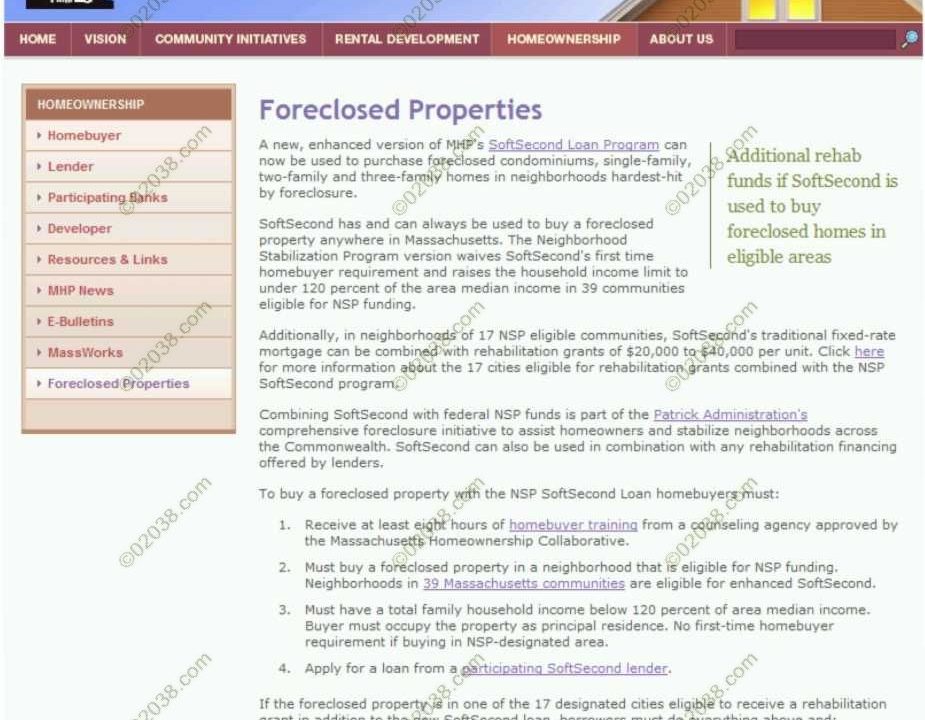
Massachusetts recently announced modifications to the previously existing “SoftSecond” loan program which are aimed at encouraging low-and-moderate income buyers to purchase foreclosed homes in designated hard-hit areas of 39 Massachusetts communities.
The modifications to the traditional SoftSecond loan program created an “Enhanced SoftSecond” program.
The key features of the Enhanced SoftSecond program include:
• Broadened loan eligibility. (You do not have to be a first time home buyer as is required under the traditional SoftSecond program.)
• Increased income ceilings. (Income limits under the Enhanced SoftSecond program were raised to up to 120% of the median income in each of the designated areas of the 39 communities covered.)
• Low down payment and no PMI. (As low as 3% down.)
• You must occupy the home as your principal residence. (Single family homes, condominium units, and multi-family properties with up to 3 units are eligible.
Foreclosed homes in designated areas of the following 39 Massachusetts communities are eligible for Enhanced SoftSecond purchase money mortgage loans: Attleboro, Barnstable, Billerica, Boston, Brockton, Chelsea, Chicopee, Dracut, Everett, Fall River, Falmouth, Framingham, Fitchburg, Haverhill, Holyoke, Lawrence, Leominster, Lowell, Lynn, Marlborough, Marshfield, Methuen, Milford, New Bedford, Peabody, Plymouth, Quincy, Randolph, Revere, Salem, Saugus, Somerville, Springfield, Stoughton, Taunton, Wareham, Weymouth, Worcester, and Yarmouth.
In an additional move aimed at encouraging the purchase of foreclosed homes in designated Massachusetts communities, the Enhanced Softsecond loan program has been further improved by giving Enhanced Softsecond borrowers access to property rehabilitation grant money via the Neighborhood Stabilization Program (NSP), a Federal program.
NSP grants will pay home buyers to renovate the foreclosed homes they purchase under the Enhanced SoftSecond program.
Grants are available if the foreclosed property is located in select areas of 17 Massachusetts communities: Boston, Brockton, Chelsea, Chicopee, Fall River, Fitchburg, Haverhill, Holyoke, Lawrence, Leominster, Lowell, Lynn, New Bedford, Revere, Somerville, Springfield and Worcester.
As much as $20,000 will be available for renovations of single-family homes and and up to $40,000 will be granted for renovations of two- and three-family homes.
Click here learn more about the Enhanced SoftSecond and NSP rehabilitation grant program in Massachusetts for low and moderate income buyers of foreclosed homes.
Did you know that foreclosed homes are for sale on the MLS? Click here to see all homes for sale in select regions of Massachusetts!
Copyright ©2009 02038.com
[post_title] => New Incentives to Buy Foreclosed Homes
[post_excerpt] =>
[post_status] => publish
[comment_status] => open
[ping_status] => open
[post_password] =>
[post_name] => buy-foreclosed-homes
[to_ping] =>
[pinged] =>
[post_modified] => 2009-03-03 06:14:17
[post_modified_gmt] => 2009-03-03 11:14:17
[post_content_filtered] =>
[post_parent] => 0
[guid] => http://www.02038.com/?p=2947
[menu_order] => 0
[post_type] => post
[post_mime_type] =>
[comment_count] => 0
[filter] => raw
[post_category] => 0
)
[2] => WP_Post Object
(
[ID] => 2919
[post_author] => 2
[post_date] => 2009-03-01 10:36:21
[post_date_gmt] => 2009-03-01 15:36:21
[post_content] => Buying a home from a bank after the foreclosure auction can be very lucrative. And by buying a foreclosed property, you are performing an important function in helping stabilize the real estate market in general as well as the neighborhood in which the home is located.
But REO home sales carry a hidden problem for prospective purchasers: the properties frequently have been “winterized” to protect them from the cold Massachusetts weather.
If you’ve ever seen a home that has had burst pipes, you know the terrible damage water can cause to a structure.
Where a water pipe bursts on an upper floor, the water damage quickly spreads. Ceilings on lower levels collapse, walls sprout mold, wood floors buckle – whole sections of a structure must be gutted if water runs unabated for even one day. It’s easy to run up repair bills of $50,000 and more.
That’s why lenders which foreclose on properties during the cold winter months in MA will “winterize” the structure immediately upon taking title at the auction.
They turn off the utilities, drain all pipes and often add anti-freeze. Sometimes electrical service is left on, but everything else is turned off, disabled and drained.
This creates a lot of challenges for the post-foreclosure marketing and sale of REO homes.
It’s impossible for buyers to do a full home inspection of a winterized home.
“Dry” inspections are easily done, but there’s no way to judge the functioning and condition of the home’s heating and plumbing systems. You just assume the risk of undiscovered problems with mechanical systems if you buy a home with only a “dry” home inspection.
Buyers may get the REO lender’s OK to pay to dewinterize the structure for a home inspection, but the buyer will also have to foot the bill to re-winterize the place after the inspection is done. Together, the dewinterize/rewinterize process can cost well over $1,000.
You can say everything is negotiable and seek to get the REO lender to pay to dewinterize and rewinterize a property.
Some REO lenders will pay at least part of the dewinterize/rewinterize costs. But communications with REO lenders (or their 3rd party asset management company) are notoriously slow and difficult. Many buyers give up on a REO purchase in frustration after lots of lost time.
Lack of open, easy communications between real estate agents and REO lenders greatly complicates inspections and sales of REO properties. It’s the part of the buyers’ cost of doing business with REO properties.
Copyright ©2009 02038.com
[post_title] => How to Inspect a Foreclosed Winterized Home
[post_excerpt] =>
[post_status] => publish
[comment_status] => closed
[ping_status] => closed
[post_password] =>
[post_name] => foreclosed-winterized-homes
[to_ping] =>
[pinged] =>
[post_modified] => 2009-03-01 12:10:01
[post_modified_gmt] => 2009-03-01 17:10:01
[post_content_filtered] =>
[post_parent] => 0
[guid] => http://www.02038.com/?p=2919
[menu_order] => 0
[post_type] => post
[post_mime_type] =>
[comment_count] => 0
[filter] => raw
[post_category] => 0
)
[3] => WP_Post Object
(
[ID] => 2761
[post_author] => 2
[post_date] => 2009-02-22 10:30:29
[post_date_gmt] => 2009-02-22 15:30:29
[post_content] => Buying a home at foreclosure auction or from a lender post-foreclosure is a very hot topic these days. And where there’s widespread popular interest in a complicated, poorly understood aspect of life involving lots of money, the scam artists are quick to set up shop.
It seems there are hundreds of web sites featuring photos of nice homes going to foreclosure auction here in Massachusetts and across the United States. Many of these sites sell access to what they say are lists of names and addresses of homeowners facing foreclosure and inventories of bank owned homes.
There are safe, secure ways to peruse pre-and-post-foreclosure sale information on the Internet.
But unless you know for sure the web site you’re visiting is honest and reputable, you should think twice before paying for access to foreclosure lists. Guard your credit card information carefully!
Here’s what I found yesterday when I was doing real estate searches on Google:
I have blanked out the name of the company that is running the advertisement shown above. I do not identify this company in this post in any way.
The company is touting what it purports to be a home in pre-foreclosure status. The street name (without house number) is given along with an image of the house and a map showing the general location in Franklin, MA are displayed.
To get the complete address and details about this upcoming foreclosure sale, you need to register with the company and give them your credit card number (‘only an initial $1.49 charge – cancel any time!’).
There’s a big problem with this ad: this foreclosure sale was held 6 months ago!
I attended this foreclosure auction with one of my clients and he was the successful bidder. He bought the home, fixed it up (including adding central heat to unheated 2nd floor). He then listed the property for sale with me and I successfully sold this home late last year to a nice young couple.
Here’s the home as one of my “sold” listings.
Yet this home is now being actively advertised as being in “pre-foreclosure” by a company that wants your credit card number. The ad is showcased on AOL Real Estate which states the ad was first placed with them February 18, 2009. (I contacted the current owners who assured me they are current on their mortgage and very happy with their home.)
I Googled the company’s name with the term “complaint” and got back quite a number of hits detailing what look to be many consumer grievances against this company. Many consumers allege they are the victims of fraudulent credit card billings by this firm. I have no personal knowledge of whether these allegations are true. All I am doing here is relaying that others have posted complaints about their experiences with this company.
Don’t become a victim of Internet fraud. Maintain a good dose of skepticism about what you see on-line concerning foreclosures – until you are sure about with whom you are dealing, keep your credit card information to yourself!
Copyright ©2009 02038.com
[post_title] => Foreclosure Web Sites & Credit Cards Equal Trouble
[post_excerpt] =>
[post_status] => publish
[comment_status] => closed
[ping_status] => closed
[post_password] =>
[post_name] => foreclosure-sites-credit-cards
[to_ping] =>
[pinged] =>
[post_modified] => 2009-02-22 10:36:14
[post_modified_gmt] => 2009-02-22 15:36:14
[post_content_filtered] =>
[post_parent] => 0
[guid] => http://www.02038.com/?p=2761
[menu_order] => 0
[post_type] => post
[post_mime_type] =>
[comment_count] => 0
[filter] => raw
[post_category] => 0
)
[4] => WP_Post Object
(
[ID] => 1694
[post_author] => 2
[post_date] => 2009-01-30 13:05:52
[post_date_gmt] => 2009-01-30 18:05:52
[post_content] => Short sales are attempts by financially distressed homeowners to sell their homes before the properties go to foreclosure auction.
The short seller knows that the market value of his home is less than the amount of mortgage debt he owes on the property. The seller will be “short” at the closing: he lacks the extra money he needs over the selling price to pay off the balance owed on the promissory note.
Sometimes the amount of the shortfall can be $10,000s or even more than $100,000.
The short seller is marketing the home as a “short sale” in the hope of using purchase offers from buyers to convince the lender to accept the sale and write off the shortfall between selling price and mortgage debt.
A lender sometimes will agree to the short sale to save on the considerable costs involved with a foreclosure.
The word “sometimes” in the sentence above is the big flaw with short sales.
Many buyers over the past couple of years have made an offer on a short sale listing and have wasted weeks and even months waiting for the lender to approve the sale only to find that the lender eventually rejects selling at anywhere near the price the buyer wants to pay.
The buyer gets his deposit money back and is left looking for another home to buy.
And the home seller may keep on marketing the home on the MLS hoping that the lender will eventually change its mind and accept a short sale. Or the home goes to foreclosure and becomes a “REO” listing. (Click here to learn more about REO home sales.)
So an attempt to complete a short sale is fraught with pitfalls and may not be appropriate for either home sellers or home buyers.
Copyright ©2009 02038.com
[post_title] => What is a Short Sale
[post_excerpt] =>
[post_status] => publish
[comment_status] => open
[ping_status] => open
[post_password] =>
[post_name] => what-is-short-sale
[to_ping] =>
[pinged] =>
[post_modified] => 2009-01-30 14:51:38
[post_modified_gmt] => 2009-01-30 19:51:38
[post_content_filtered] =>
[post_parent] => 0
[guid] => http://www.02038.com/?p=1694
[menu_order] => 0
[post_type] => post
[post_mime_type] =>
[comment_count] => 0
[filter] => raw
[post_category] => 0
)
[5] => WP_Post Object
(
[ID] => 1689
[post_author] => 2
[post_date] => 2009-01-30 12:37:14
[post_date_gmt] => 2009-01-30 17:37:14
[post_content] => Real Estate Owned (REO) sales are increasingly common on the MLS in Massachusetts.
These REO sales are post-foreclosure offerings by the lender often via an agent using the MLS. So most REO homes are easy to find and any agent with MLS access can show these listings.
As you will find when you look at the insides of a majority of REO homes, there often are a lot of structural problems and mechanical defects. And the utilities are almost always disconnected, making a full home inspection nearly impossible.
The lender (who has become the property owner) will rarely fix any defects for you.
Often the cost of repairs when added to the price the lender wants greatly exceeds what the market value of the home will be once the repairs are done. The lender often dismisses low offers out of hand, holding out for a high sale price.
So quite a number of REO homes sit unsold on the MLS for months as the asking price slowly drops as the lender feels its way down to the home’s “as is” market value.
Still you can find some compelling REO deals if you work hard at eliminating the money pits!
Copyright ©2009 02038.com
[post_title] => REO Sales Explained
[post_excerpt] =>
[post_status] => publish
[comment_status] => open
[ping_status] => open
[post_password] =>
[post_name] => reo-sales-explained
[to_ping] =>
[pinged] =>
[post_modified] => 2009-01-30 12:37:14
[post_modified_gmt] => 2009-01-30 17:37:14
[post_content_filtered] =>
[post_parent] => 0
[guid] => http://www.02038.com/?p=1689
[menu_order] => 0
[post_type] => post
[post_mime_type] =>
[comment_count] => 0
[filter] => raw
[post_category] => 0
)
)
[post] => WP_Post Object
(
[ID] => 3239
[post_author] => 2
[post_date] => 2009-03-26 15:14:31
[post_date_gmt] => 2009-03-26 20:14:31
[post_content] => “After weeks of negotiating the purchase (of a bank-owned home) . . . it turned out the bank didn’t actually own the property, and had wrongfully foreclosed on the home.”
This amazing quote is from an irate employee of an affordable housing organization trying to buy a foreclosed home.
The man wasted weeks of time and effort dealing with the seemingly overworked and overwhelmed loss mitigation department of a major lender. The department didn’t even know the bank didn’t have ownership rights to this home, one of the hundreds of foreclosed properties it was trying to sell!
This cautionary story appears in the current edition of Banker and Tradesman, the respected Massachusetts real estate trade publication.
It illustrates the nightmare of frustration and wasted time sometimes encountered by buyers seeking to buy REO (bank-owned) property.
Quoting again from the article:
“Lenders have been woefully unprepared to deal with the administration and listing of their properties; often, they aren’t even aware that a property is theirs.”
A look at the numbers helps explain why REO lenders are often so dysfunctional with the management and sale of foreclosed properties: there are approximately 5000 REO properties currently in Massachusetts, according to The Warren Group, publisher of Banker & Tradesman. Of those, about 1,700 are being administered by US Bank and Deutsche Bank, the two largest servicers of REO properties in the state.
That’s a lot of homes to handle!
When you add in the 1000s of short sales that are currently ongoing in MA, you can imagine how much potential there is for misunderstandings, delays and mistakes while trying to negotiate a transaction with the loss mitigation staff of a lender.
While there are good deals to be had with REO homes and short sales, just beware that many buyers are reporting frustrations and blown deals due to the inability of the lenders to cope with all the bad mortgage loans that keep landing on their doorsteps.
Copyright ©2009 02038.com
[post_title] => Delays, Mistakes Common with REO & Short Sales
[post_excerpt] =>
[post_status] => publish
[comment_status] => open
[ping_status] => open
[post_password] =>
[post_name] => delays-mistakes-reo-short
[to_ping] =>
[pinged] =>
[post_modified] => 2009-03-26 18:40:01
[post_modified_gmt] => 2009-03-26 23:40:01
[post_content_filtered] =>
[post_parent] => 0
[guid] => http://www.02038.com/?p=3239
[menu_order] => 0
[post_type] => post
[post_mime_type] =>
[comment_count] => 0
[filter] => raw
[post_category] => 0
)
[queried_object] => stdClass Object
(
[term_id] => 264
[name] => Foreclosure Sales
[slug] => foreclosure-sales
[term_group] => 0
[term_order] => 0
[term_taxonomy_id] => 269
[taxonomy] => post_tag
[description] =>
[parent] => 0
[count] => 6
)
[queried_object_id] => 264
)
by Warren Reynolds on March 26, 2009
“After weeks of negotiating the purchase (of a bank-owned home) . . . it turned out the bank didn’t actually own the property, and had wrongfully foreclosed on the home.” This amazing quote is from an irate employee of an affordable housing organization trying to buy a foreclosed home. The man wasted weeks of time [...]
Tagged as:
Foreclosure Sales,
REO Homes,
Short Sales
by Warren Reynolds on March 3, 2009
If you’re interested in buying a foreclosed home in Massachusetts and will live in the property as your principal residence, there is a new program that may help you. Massachusetts recently announced modifications to the previously existing “SoftSecond” loan program which are aimed at encouraging low-and-moderate income buyers to purchase foreclosed homes in designated hard-hit [...]
Tagged as:
Foreclosure Sales,
SoftSecond Loans
by Warren Reynolds on March 1, 2009
Buying a home from a bank after the foreclosure auction can be very lucrative. And by buying a foreclosed property, you are performing an important function in helping stabilize the real estate market in general as well as the neighborhood in which the home is located. But REO home sales carry a hidden problem for [...]
Tagged as:
Foreclosure Sales,
Home Inspections,
REO,
Winterized Homes
by Warren Reynolds on February 22, 2009
Buying a home at foreclosure auction or from a lender post-foreclosure is a very hot topic these days. And where there’s widespread popular interest in a complicated, poorly understood aspect of life involving lots of money, the scam artists are quick to set up shop. It seems there are hundreds of web sites featuring photos [...]
Tagged as:
Foreclosure Sales,
Home Buyer Tips
by Warren Reynolds on January 30, 2009
Short sales are attempts by financially distressed homeowners to sell their homes before the properties go to foreclosure auction. The short seller knows that the market value of his home is less than the amount of mortgage debt he owes on the property. The seller will be “short” at the closing: he lacks the extra money [...]
Tagged as:
Foreclosure Sales,
Home Seller Tips,
Short Sales
by Warren Reynolds on January 30, 2009
Real Estate Owned (REO) sales are increasingly common on the MLS in Massachusetts. These REO sales are post-foreclosure offerings by the lender often via an agent using the MLS. So most REO homes are easy to find and any agent with MLS access can show these listings. As you will find when you look at the insides [...]
Tagged as:
Foreclosure Sales,
REO